 +
+
This guide is for product and growth teams that may copy a popular rival video without knowing why it works. TikTok competitor analysis for Shopify stores should find the buyer question behind the content. It should not become a list of clips to copy. The body-care case below compares two substitute formats and turns their difference into a completed creative-gap brief.
Write one comparison question before opening KOLSprite. In this case, the question is whether a shopper should choose a reusable net sponge or a ready-to-use exfoliating pad for one routine. The gap is not what competitors missed. It is what your store can prove better. Product, shop, and linked-video context keep that judgment tied to the real products, not the best-looking clip. Shopify still has to show the product facts, offer, rules, and page details. TikTok views cannot prove any of them.
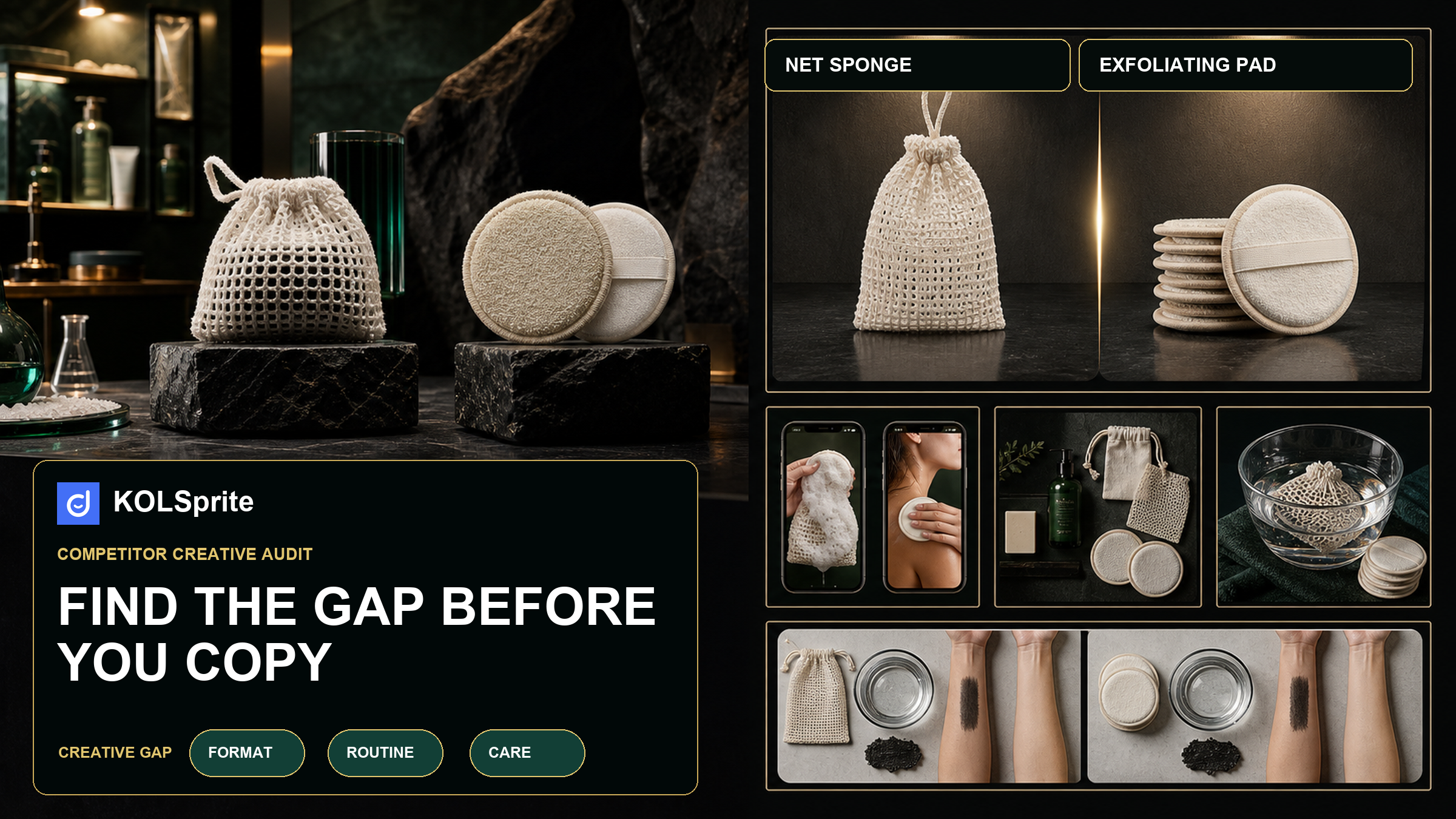
Bellanomi's African net sponge and medicube's exfoliating pad are not the same product. One is a reusable shower tool; the other is a skin-care pad. It would be wrong to compare them as if they were the same. Comparing them as substitutes for a body-exfoliation routine is useful because the format changes the demonstration, price, care questions, and creator story.
That point became clear when the broad "body scrub" search also returned household cleaning brushes. We removed the wrong items and followed exact product IDs into linked videos. The loose keyword became a clear choice: help the buyer pick a format instead of copying the loudest hook.
Start with one product category and one question. For body care, ask whether videos focus on texture, daily routine, ingredients, gifting, or a certain use case. A clear question tells the team what to watch for after the first few seconds.
For each useful video, note the buyer, the problem, what the creator shows, the main concern, the offer, and the close. Also note what the video does not explain. A missing answer may give your next video or product page a better idea than the hook itself.
A broad US product search for “body scrub” also returned household cleaning brushes. Those wrong results marked the category boundary more clearly than the keyword did. After removing them, we selected two body-exfoliation offers: Bellanomi’s African net sponge and medicube’s exfoliating pad. They are different products for a similar need because they solve a similar routine problem with different formats and price points.
| Product snapshot | Observed product fields | Selected video pattern |
|---|---|---|
| Bellanomi African net sponge | $8; 11,807 recorded 30-day units; 4.8 rating; 63,730 reviews | Three selected videos ranged from 17.9M to 28.5M plays and emphasized back reach, softness, and shower routine |
| medicube exfoliating pad | $27; 9,017 recorded 30-day units; 4.4 rating; 1,400 reviews | Three selected videos ranged from 3.0M to 11.8M plays and emphasized pad format, exfoliation, and skin-care routine |
The comparison is useful because the product formats, prices, proof, and creator stories differ. It does not tell a Shopify merchant which offer is more profitable. The fields are TikTok Shop snapshots, and the selected videos are examples rather than a complete content history.
Shop context adds another check. Bellanomi's shop search showed 24 products and a 4.8 shop rating. The medicube US Store showed 186 products and a 4.6 shop rating. A focused specialist and a large beauty store may use very different content systems. Compare the buyer problem and the demonstration, not their raw totals.
Research snapshot. KOLSprite product, shop, and product-linked video searches; US market; accessed July 22, 2026. Household-cleaning false positives were removed. Two body-exfoliation products, two shops, and three linked videos per product were reviewed. Recorded sales and engagement fields are directional platform snapshots, not reviewed revenue or Shopify performance.
A creative gap is not a new color palette or a louder hook. Here, the useful question is how each format fits a real body-care routine. The video should show the difference. The product page should finish the answer with use, care, and skin-sensitivity details that the store can support.
Test one question at a time. Name the common pattern, the answer that is still missing, the proof your product can show, and the result that would earn another test. This keeps the team from copying a polished clip while missing the choice the buyer is trying to make.
Produce one fair format-choice video. Show how the reusable net sponge and the ready-to-use pad fit different routines without claiming that one is universally better. Send viewers to a page that explains use and care. Stop the angle if comments show more confusion about the difference after the test.
A useful gap can be written as a buyer question. For these two exfoliation products, ask three questions. Who should choose a reusable net sponge rather than a pad? How does each format fit into a routine? What care or skin-sensitivity limits should the store explain?
That question is better than “make a different body-care video.” It tells the creator what to demonstrate and tells the product-page team what it must answer. It also makes the result easier to judge. If viewers still ask the same question after the new content and page update, the explanation did not work.
Choose one question for the first test. Do not combine format, ingredients, routine, price, and results in a single asset. A narrow test gives the team a clear reason to continue, revise, or stop.
Start with the TikTok UGC strategy guide to define the buyer problem and proof standard before you compare individual competitor videos.
Start with KOLSprite product search and remove items that do not match the category. Then use TikTok video search with the product ID to review videos tied to the same item. Save the links and your notes in a simple review sheet.
If comments matter, open AI Comment Analysis in a supported comment area. Check a few original comments before you use a common question in the brief. The final brief should show the common story, the missing buyer answer, the proof your store can provide, and one fair test.
A TikTok video is only the start of the buying path. The store page, price, bundle, shipping promise, and support answers also shape the result. Follow the path a viewer would take. Check whether the store supports the promise made in the video.
Your store can be different without copying another brand's style. It may give clearer use steps, show a more realistic demo, explain care better, or make the offer easier to understand. Choose one answer that your whole store can support.
Shopify's product-positioning guide explains why a store needs one clear reason for shoppers to choose the product. Use that reason to keep the video, product details, and store message focused on the same buyer problem.
Write the idea so the test can prove it wrong. For example, body-care videos may show texture but leave buyers unsure about the daily routine. A short routine video can test whether a clearer answer helps.
The point is not to say that competitors are bad. It is to name one question their public content seems to leave open. Then show the answer with your real product. If the idea is about use, show the use. If it is about fit, give exact size details. If it is about care, explain the steps clearly. This is what makes TikTok competitor analysis for Shopify stores a source of testable decisions instead of a swipe file.
| Buyer question | Should I choose a reusable net sponge or a ready-to-use exfoliating pad? |
|---|---|
| Observed category pattern | High-play videos make texture and routine visually satisfying, but a short clip may leave format choice, care, and skin-sensitivity limits unclear. |
| Creative gap | A side-by-side routine explanation that shows who each format is for, how it is used, and what care or sensitivity information belongs on the product page. |
| Proof the store can provide | Material, dimensions, use steps, care instructions, ingredient or formula details where applicable, price, shipping, and return policy. |
| Video test | Open with the choice, demonstrate one real use for each format, state one limitation, and send viewers to a page that answers the same question. |
| Success signal | Fewer basic format questions, more product-specific questions, qualified store visits, and behavior that can be linked to the test. |
This brief is more useful than a list of viral hooks because every line can be checked against the product and store. It also gives AI Comment Analysis a focused follow-up question: after the new video, are viewers still confused about format, routine, or care?
Drop the idea if the products are too different for a fair side-by-side demo. Drop it if the store cannot support the care or skin facts. Stop if the new video creates the same confusion. A content gap is not automatically an opportunity. It is a question that deserves one controlled answer.
Public TikTok data cannot show either shop's profit or a Shopify store's sales rate. State that limit once beside the final call. Repeating it would add caution but no help.
This method works whenever shoppers choose between formats or routines. In coffee, compare pods with a manual brewer around speed, cleanup, and control. In pet care, compare wipes with a rinse product around convenience and coat type. In home organization, compare a fixed rack with modular bins around space, setup, and the items each format can hold.
The buyer question remains the center of the brief. Keep the exact products and videos attached to the research so the comparison does not drift into a claim about an entire category. Then decide which proof your own store can provide. A product page may need dimensions, ingredients, care instructions, a comparison table, or a clearer returns policy before the video can make a useful promise.
Measure the first test against the question it was designed to answer. Look for relevant comments, product-page behavior, add-to-cart movement, and support questions rather than views alone. Continue when buyers understand the difference and the page supports it. Revise or stop when the comparison creates more confusion than clarity.
Create a KOLSprite account and claim a three-day trial membership. Use the trial to explore the KOLSprite research workflow behind this article.
Register for a three-day KOLSprite trial
Bring the buyer question, the two formats, and the proof your store can provide to the KOLSprite Discord community. The most useful feedback will test whether the comparison is fair and whether the proposed answer is visible on camera.
 +
+
Discuss a Shopify creative-gap brief
Produce one format-choice video, not a general body-care montage. Copy the buyer question, not the competitor's clip. Let KOLSprite keep the product, shop, video, and comment facts linked. Let the Shopify page finish the answer. Continue only if your own comments and store behavior show that the clearer answer helped.
Latest Articles

As an essential, data-driven toolkit for TikTok influencers and marketers, KOLSprite provides powerful features for effortless creator discovery, trending content identification, and actionable real-time insights.
It empowers users to make smarter decisions and significantly boosts their TikTok business.
 Refer & Earn