 +
+
If you manage Amazon inventory and use TikTok to spot demand, the hard part is not finding a hot item. It is deciding whether the signal arrived early enough to test without getting stuck with late stock. This guide shows how to evaluate seasonal products with a fixed test window. You will combine Amazon lead times and private economics with KOLSprite product and video evidence. The result is a dated decision: test now, wait for the next cycle, or reject the idea. It is not a forecast of how many units TikTok will sell.
Start with the last useful selling date and work backward. If sourcing, inbound shipping, Amazon receiving, content production, and one measured test do not fit before that date, the trend is too late for a normal inventory bet. TikTok can help you judge whether the product has fresh, repeatable proof. It cannot erase the calendar.
A strong signal with no safe test window is still a bad order.
Seasonal research often begins with a chart. A better starting point is a calendar. Write the date when the product loses most of its urgency. For a portable fan, that date may depend on the market, climate, travel calendar, school schedule, and the product's other uses. Then subtract every step required to learn something useful.
The steps usually include supplier confirmation, sample delivery, compliance review, packaging changes, creator or in-house production, listing work, inbound freight, Amazon receiving, and a test period. Add a delay buffer. The remaining days are the real opportunity window. If only a week remains, an attractive TikTok chart may be useful for next year, not for a large purchase order today.
Amazon says its demand forecast can project future demand for up to 40 weeks using past orders, active deals, and seasonal patterns. Its inventory guidance also tells sellers to plan ahead for receiving and storage limits. That first-party view belongs in the decision because it reflects your own catalog. TikTok adds a different question: can people still show a timely reason to care?
We used KOLSprite to review a US search for portable fans on July 30, 2026. The first page mixed handheld fans, desktop fans, a misting fan, and a tower fan. We did not average them. Their prices, use cases, shipping profiles, and buying moments were too different.
One CoolHill handheld fan was listed at $16.90. Its record showed 21,706 units in the latest 30-day field, 8,311 in the latest seven-day field, a 4.3 rating, 14,659 reviews, 1,695 linked creators, and 7,141 linked videos. Its seven-day growth field was negative 20.8%, while its 30-day growth field was positive 139.04%. That combination matters. The larger window looked strong, but the shorter window had cooled.
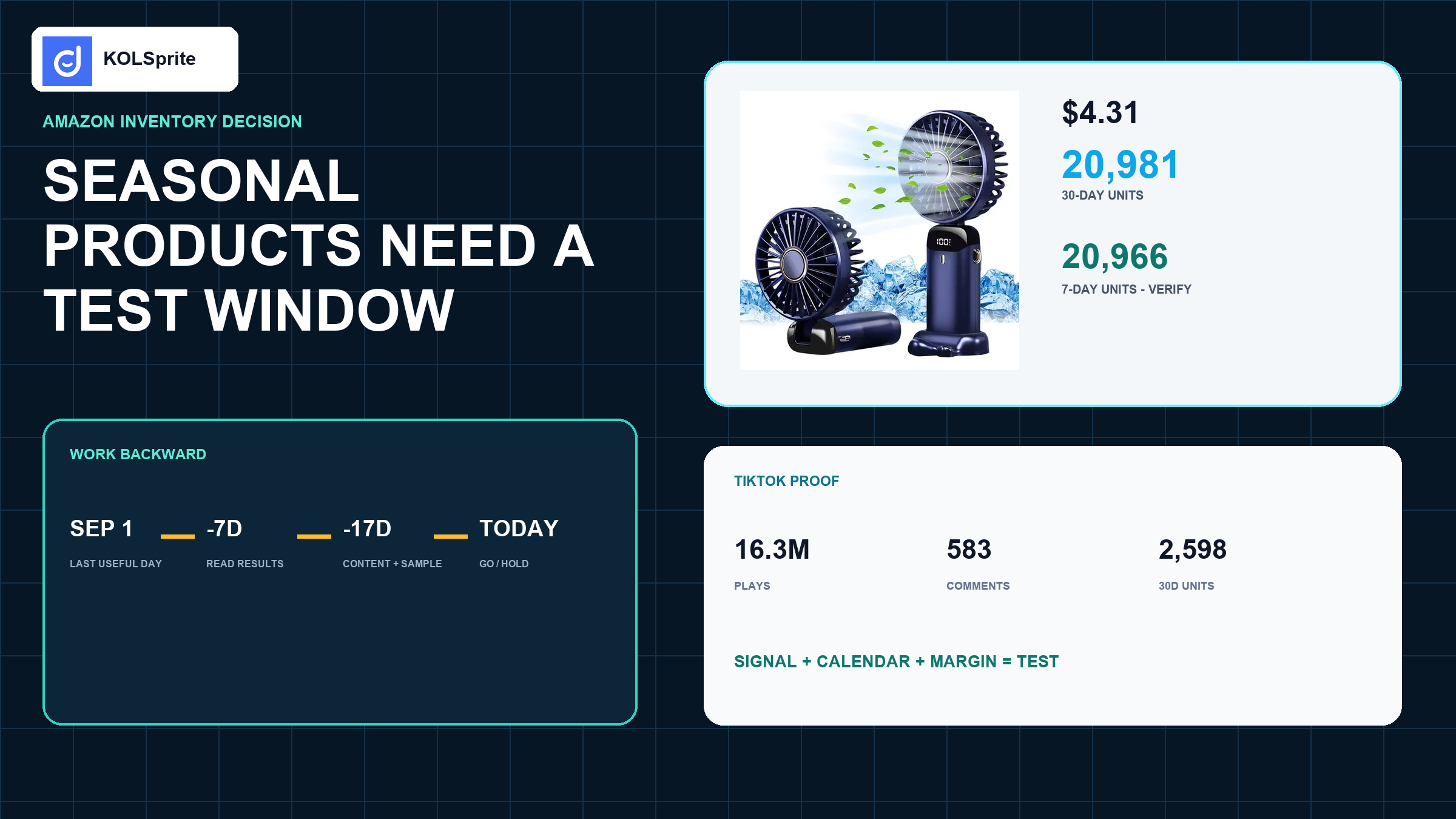
Another lightweight fan was listed at $4.31. Its record showed 20,981 units in the 30-day field and 20,966 in the seven-day field, with unusually large growth values. That is a reason to inspect the exact listing and data history, not a reason to copy its price or order its apparent volume. A third tower fan was listed at $50.98 and had a very different home-use job. It did not belong in the handheld travel set.
Research note. KOLSprite US product and commerce-video records, accessed July 30, 2026. Five product records were reviewed, then separated by product form and buyer job. Public figures are directional platform fields. They are not audited revenue, complete market demand, or a forecast for an Amazon ASIN.
The leading commerce videos did not sell a generic object called a fan. They sold specific moments. One 27-second theme-park clip showed a $16.90 handheld fan and had 16.3 million plays, 583 comments, a 1.62% interaction field, and 2,598 recorded 30-day product units. A 30-second deal clip positioned a fan as a summer purchase and had 9.4 million plays, 178 comments, and 2,539 recorded 30-day units.
Other clips framed the item as a dorm-room cooler, a travel essential, or a personal air conditioner. The proof was portable relief in a hot setting. That is more useful than the view count alone. It tells the Amazon team what must be true for the item to travel across channels: the product needs a clear setting, visible air movement or cooling behavior, believable portability, and a reason to act before the weather changes.
Use KOLSprite product search to clean the product set, then follow exact product IDs into video search. This keeps a popular theme-park clip from being attached to the wrong fan or price. It also reveals whether several creators can make distinct proof, which matters more than one exceptional post.
| Gate | Question | Evidence to use | Stop rule |
|---|---|---|---|
| Calendar | Can one useful test finish before urgency fades? | Last selling date, lead time, receiving time, content schedule | No safe review date remains |
| Product | Is the exact product form active? | Cleaned KOLSprite product records and recent fields | Only adjacent or mismatched items look active |
| Proof | Can more than one creator show a real use case? | Exact product-linked videos, settings, questions, and demonstrations | Interest depends on one creator or one unsupported claim |
| Economics | Can a capped test survive fees and returns? | Landed cost, Amazon fees, coupon, returns, storage, markdown risk | Contribution margin fails under a modest downside case |
| Operations | Can the item arrive and be supported? | Supplier, compliance, inventory, customer service, and fulfillment facts | Delay or compliance risk consumes the season |
This framework avoids a fake composite score. A 92 out of 100 can hide a fatal timing problem. Gates are harder to ignore. The item moves forward only when the calendar, proof, economics, and operations all support a small test.
Suppose the team believes September 1 is the last day when a portable-fan test can guide a meaningful Amazon decision. Subtract seven days for results, seven days for listing and creative preparation, ten days for samples and filming, and a receiving buffer. If the calendar already reaches the present, there is no room for a normal test. The team can use local stock, a supplier-held batch, or a next-season research plan, but it should not pretend the original window still exists.
Now add the downside. How many units can be sold after the peak without a deep markdown? Can the product serve travel, dorm, office, or makeup use when extreme heat fades? Is the battery or electrical documentation ready? Will a price that works on TikTok still work after Amazon fees and returns? These are inventory questions, not content questions.
The KOLSprite case helps with the content side. Several settings were visible, and more than one creator had meaningful reach. The short-window slowdown on the $16.90 item argues for caution. A sensible verdict is a capped test if inventory can arrive quickly, not a broad restock based on the 30-day number.
Show the fan in a hot queue or outdoor walk. Prove battery handling, size, and airflow without making medical or temperature claims the product cannot support. The test asks whether the item solves a specific travel problem before the next holiday period.
Show the product at a desk, beside a bed, or during makeup. This angle may extend beyond one heat wave. The test asks whether the product has an everyday indoor job that lowers end-of-season risk.
Compare the space the fan takes with another travel item. Show charging and storage. The test asks whether portability is strong enough to justify choosing this form over a larger fan.
Keep the offer, product, and review window stable where possible. Change one proof job at a time. Do not copy the original creator's wording or sequence. The source videos reveal buyer moments; they do not provide a script license.
TikTok can show content momentum, but Amazon should own the inventory decision for an Amazon listing. Review last year's weekly sales, traffic, conversion, returns, storage cost, and markdown history for the closest ASIN. If the product is new, use a downside case that assumes the social signal fades earlier than expected.
A useful test budget includes the units needed for content, the smallest practical inbound lot, the cost of late inventory, and the value of the learning. If the supplier minimum is much larger than the safe test, the sourcing structure fails even when the product looks promising.
The TikTok trend research workflow for Amazon sellers is the upstream guide for combining marketplace and social evidence. The Amazon bestseller to TikTok guide is the downstream step when an existing ASIN already has strong economics and reviews.
End the review with six lines: product form, last useful selling date, exact TikTok evidence, Amazon evidence, maximum test exposure, and next review date. For this case, the memo might say: handheld travel fan; test must finish before September 1; several product-linked videos show travel and summer proof; one leading product has strong 30-day activity but weaker seven-day direction; Amazon economics and receiving time are still private; approve only a small fast-arrival test with a fixed stop date.
That memo is more useful than a folder of charts. It gives buying, content, finance, and operations the same decision. It also makes the missing facts visible. If the supplier cannot confirm delivery, the team stops. If the margin fails, the team stops. If the test finishes after the season, the team records the research for next year.
The buyer starts with the date. "We need the test result by September 1." The supply lead checks the sample and inbound plan. "A normal order will not arrive in time. A small local batch can." The content lead checks the fan videos. "We have three clear jobs to test. They are travel, dorm use, and desk use."
The finance lead does not ask how many views the best clip had. She asks, "What do we lose if the batch is late?" The team adds the cost of freight, Amazon fees, returns, and a late markdown. The safe batch gets smaller. That is not a bad result. The smaller batch fits the facts.
The team then writes a stop rule. If the item does not meet the set margin and page action by the review date, no new order is placed. If one proof job works, the next batch uses that job. If all three fail, the team keeps the notes for next summer.
This talk is plain on purpose. No one says the fan is certain to win. No one turns a TikTok spike into an Amazon forecast. Each person brings one fact that they own. The team can now act without pretending that the risk is gone.
No public TikTok field can predict Amazon unit demand. A commerce-video record does not prove that a video caused every recorded sale. Product searches may mix different forms until a human cleans them. Weather, promotions, platform distribution, and inventory can change quickly. The method reduces avoidable timing errors; it does not remove uncertainty.
The best use of KOLSprite is to make the social evidence traceable. Save the exact product, videos, creators, market, date, and proof jobs. Pair that record with your Amazon forecast and unit economics. Then make the smallest decision that can teach you something before the calendar closes.
Do not order against a 30-day spike alone. Confirm the last useful selling date, verify receiving time, and run three proof jobs with a small fast-arrival batch. If the test cannot finish before the date or the downside margin fails, hold the research for the next seasonal cycle. That is a disciplined way to evaluate seasonal products: timing first, evidence second, inventory last.
Create a KOLSprite account and claim a three-day trial membership. Use the trial to put this workflow into practice before your next product, content, or creator decision.
Register for a three-day KOLSprite trial
Share the last useful selling date, the product form, and the missing inventory facts. Other operators can challenge whether the test can finish before the season closes.
 +
+
Discuss the seasonal product decision on Discord
Latest Articles

As an essential, data-driven toolkit for TikTok influencers and marketers, KOLSprite provides powerful features for effortless creator discovery, trending content identification, and actionable real-time insights.
It empowers users to make smarter decisions and significantly boosts their TikTok business.

 Refer & Earn