 +
+
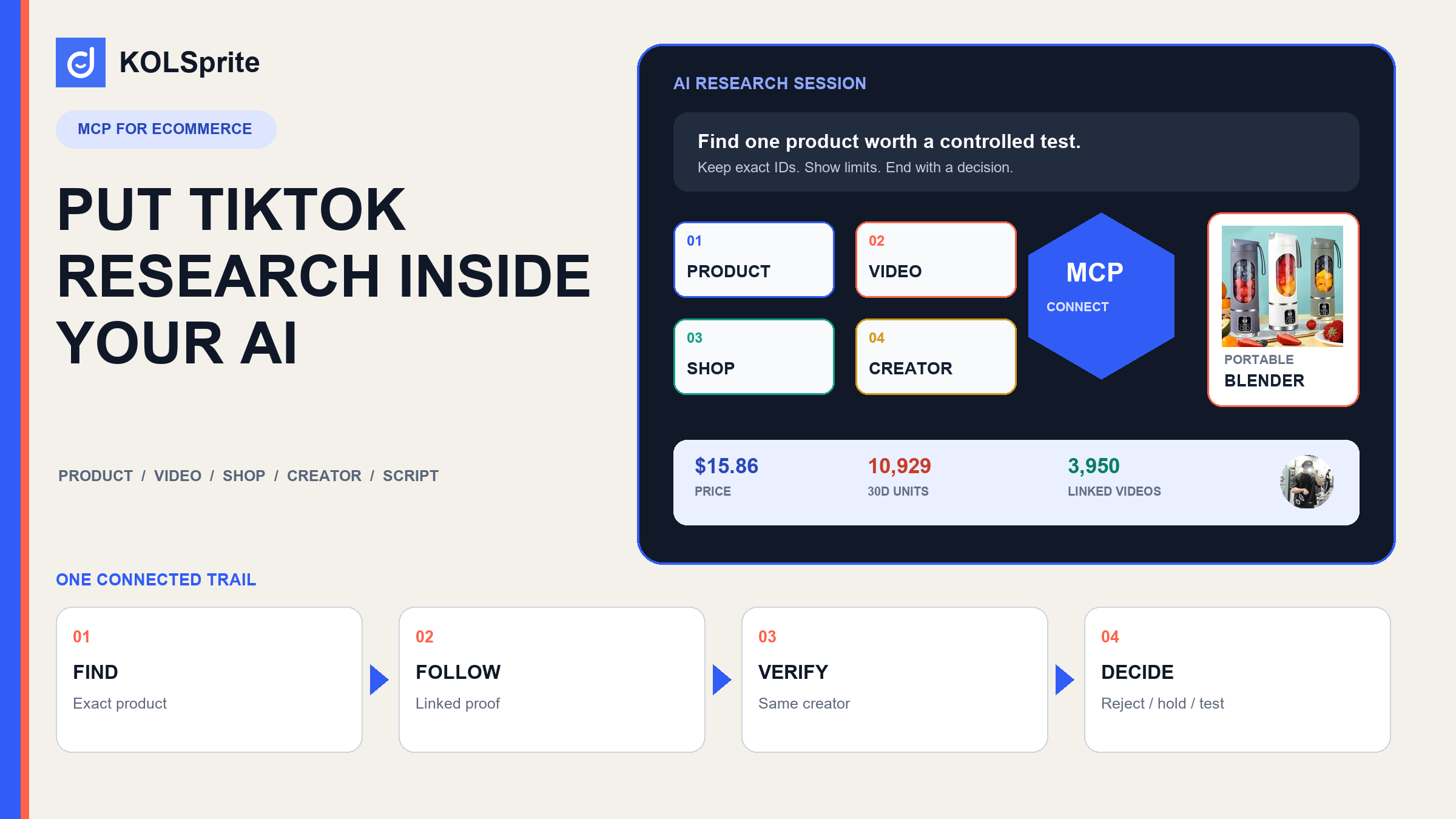
If you run an ecommerce brand, you probably use AI to write briefs, compare products, or plan creator outreach. The weak point is usually the evidence. A general AI can explain TikTok, but it cannot know which product, video, shop, or creator you mean unless it can reach a current data source. That is where MCP for ecommerce becomes useful. KOLSprite MCP lets a compatible AI client call TikTok product, video, shop, creator, and caption tools inside the conversation. This guide shows what that connection does, where it fits beside your store and payment systems, and where human judgment still matters. You will also see a live portable-blender research case and leave with a prompt that produces a small decision brief instead of a pile of raw records.
MCP does not make an AI automatically right. It gives the AI a standard way to request current, structured evidence from an outside tool. KOLSprite uses that connection for TikTok research. Your AI can find an exact product, follow it into linked videos, check the shop, verify a creator, or read a specific video's captions. You still decide whether the evidence is complete, relevant, and safe to act on.
MCP removes handoffs between the question and the evidence. It does not remove the decision.
Model Context Protocol is an open standard that links AI apps with outside systems. The official MCP introduction says it gives AI apps a common way to use data, tools, and set workflows. In simple terms, an MCP server lists named tools. Each tool has clear inputs and outputs. An AI client can find a tool, call it, and read the result.
This is not the same as asking a chatbot to recall a market fact. The model may know broad ideas from training. A seller often needs a current product record, an exact creator, or the videos tied to one item. MCP lets the model fetch that proof when the seller asks.
It is also different from a normal API project. An API is the base link that code can call. MCP describes tools in a way an AI client can read and use. An engineering team may still choose an API for a custom app or a fixed data flow. An operator may choose MCP when the work starts with a plain business question.
One MCP server rarely covers the whole business. Ecommerce teams work across store operations, payments, and market research. Those jobs need different sources and different permission levels. Treat the stack as a group of specialists rather than a single all-purpose agent.
| Job | Typical questions | Right data source | Human check |
|---|---|---|---|
| Store work | What is in stock? Which order is late? | Your store or order system | Access, customer impact, and edge cases |
| Payments | Did a payment clear? Can we refund it? | Your payment provider | Approval, fraud, and money controls |
| Market research | Which products, videos, or creators need review? | KOLSprite MCP | Fit, claims, rights, cost, and cause |
For example, Shopify documents a Storefront MCP for store actions. Stripe provides an official MCP server for payment tools. KOLSprite answers a different question. It brings TikTok research and video content into the AI workflow. The three links can work together because they do different jobs.
The KOLSprite MCP page now lists five tool areas. Product search finds TikTok Shop items and market fields. Video search finds clips and can follow an exact product or shop. Shop search checks a store record. Creator search finds and filters creator records. Caption extraction reads one video's words. The AI can then translate, sum up, or break down the script.
That scope makes KOLSprite useful as an MCP for ecommerce research rather than a store-control system. It can help an Amazon seller look for TikTok proof around an existing item. It can help a Shopify team compare content angles before commissioning UGC. It can help a TikTok Shop operator move from a product record to the videos and creators attached to it.
| KOLSprite tool | Best starting question | Useful output | Not proved by the output |
|---|---|---|---|
product_search | Is this product active? | Item, price, rating, sales, shop, creators, and videos | Margin, stock risk, or future demand |
video_search | How do creators show it? | Clips, creators, length, response, and item fields | Why it worked or reuse rights |
shop_search | What does the seller record show? | Store type, rating, item count, and sales fields | Profit or supply quality |
creator_search | Is this the exact account? | Stable ID, handle, audience, content, and public contact fields | Safety, rate, fit, or rights |
| Caption tool | What does this video say? | Words, translation, hook, proof, and CTA | Rights to copy script or footage |
The web tools remain useful when a person wants a detailed screen and filters. For example, the team can continue into KOLSprite product search or video search after the AI has prepared a short list. Creator search can then support the final account check.
To test the workflow, we asked KOLSprite for portable blenders in the United States. The broad result included milk frothers and food choppers, so the first job was cleanup. We retained one actual portable blender sold by HomeGadget Depot and followed its exact product ID into videos, the shop record, and one creator record.
| Connected record | Observed snapshot | What it suggests | What to do next |
|---|---|---|---|
| Product | $15.86; 10,929 units in 30 days; 4.3 rating; 1,923 creators; 3,950 videos | There is enough activity to keep looking | Check the trend, quality, and your costs |
| Trend | The 30-day growth field was -32.89% | Past proof does not make it a new breakout | Test the offer before buying stock |
| Linked video | 37 seconds; 6.8 million plays; 1,482 units in 30 days; unc_reviews | A travel use can reach a large group | Review the demo and buyer questions |
| Second video | 58 seconds; 7.3 million plays; Spanish caption; 1,404 units | The story can work in more than one language | Check the message in each market |
| Exact creator | ID match; 110,091 followers; 379,874 average views; 12.98% response field | The clip and account are the same record | Check recent work, fit, rights, rate, and timing Research note. KOLSprite product, video, shop, and creator records; US market; accessed July 28, 2026. The case follows product ID 1731581114818794403, shop ID 7496314189601999779, and creator ID 7439168837693981742. Values are changing platform snapshots. They are not audited financial results, a causal test, or a forecast. The broad product set was cleaned before the connected case was retained. |
The important result is not that the blender is a winner. The connected evidence argues for a smaller conclusion. The product has deep content supply and several strong examples, but the visible growth field was negative. A sensible operator would not buy inventory from the headline numbers alone. The better next move is a controlled content test, plus a margin and product-quality review.
This is where the connected workflow earns its place. The product ID prevents the AI from mixing similar products. The video record supplies the creator handle and stable ID. The creator search confirms the account. The shop record adds seller context. Each call narrows the same question instead of creating four unrelated spreadsheets.
A weak prompt asks for "the best TikTok products" and invites a broad answer. A stronger prompt names the market, decision, evidence path, stop rules, and final format. It tells the AI to preserve IDs, separate observations from interpretation, and show missing evidence.
Research portable blenders on TikTok Shop US for a Shopify brand deciding whether to run a small creator test. Clean out products that are not portable blenders. Keep exact product, shop, video, and creator IDs. For one retained product, compare product activity, trend direction, three linked video examples, shop context, and one exact creator record. Separate observed fields from your interpretation. End with a one-page decision brief: reject, hold, or test; three reasons; three unknowns; owners; and the next seven-day action. Do not recommend inventory or outreach unless the evidence supports it.
The AI may use several tools, but the public result should stay small. A good answer names the exact item. It shows the proof that changed the call. It also states the limits and next step. Do not expose pages of raw JSON or every cleanup step. Keep the research trail in the work record. Bring the decision brief to the meeting.
KOLSprite MCP should not replace every KOLSprite workflow. It works best when a seller starts inside a supported AI client and wants the same type of result each time. The AI can plan calls, link records, sum up the proof, and format the answer.
The browser extension is better while a person browses TikTok. It keeps the product, clip, creator, comments, captions, and saved research close to the source page. The web platform is better for deep filters, record checks, exports, and team work on a visual screen.
| Surface | Use it when | Strongest advantage | Typical handoff |
|---|---|---|---|
| KOLSprite MCP | You start in an AI client | Linked research and a clear output | Send IDs and the next call for review |
| Browser extension | You find a clue on TikTok | Data, captions, and context by the source | Move good items into a brief or list |
| Web platform | You need deep filters and a visual screen | More detail on items, clips, and creators | Export or assign the next task |
The practical pattern is simple: browse to notice, use MCP to connect, and return to the web or source page to verify. The surfaces support one workflow. They do not need to compete for every step.
Current data can improve a decision, but it cannot finish every part of it. A product record does not know your landed cost. A video record does not prove that one hook caused sales. A creator record does not prove audience quality or commercial availability. A transcript does not grant permission to reuse a script.
Keep five human gates after any MCP answer:
This is also why a good MCP for ecommerce workflow includes uncertainty. An AI that reports a clean "winner" without showing the missing evidence is less useful than one that recommends a narrow test.
Do not begin with a complex autonomous agent. Begin with a task you repeat every week, such as rejecting weak product ideas, verifying a creator from a source video, or turning three clips into one testable brief. When the output is reliable, add the next source to the stack.
| Team | Starting question | KOLSprite path | Finished artifact |
|---|---|---|---|
| Amazon seller | Can this ASIN support a TikTok test? | Product to clips to creators | Test-or-hold card with three proof ideas |
| Shopify brand | Which angle can our product prove? | Video, caption, and creator review | Brief with one test change |
| TikTok Shop team | Is this item still growing across creators? | Product, shop, and linked clips | Trend memo with stop rules |
If your next step is creator work, use KOLSprite to verify the exact account before writing the message. The cross-platform creator discovery guide explains how to move from broad research into a useful short list. If the task is content research, the AI comment analysis workflow helps turn buyer questions into a better brief without treating comments as a vote count.
KOLSprite MCP is useful when your ecommerce team already asks AI to research TikTok but needs current, connected evidence. It gives the AI a direct route to product, video, shop, creator, and caption tools. The strongest first use is not autonomous buying or mass outreach. It is a bounded research task with exact IDs, a visible evidence trail, a clear limitation note, and one decision artifact. Connect the data, keep the judgment, and make the next action smaller and more defensible.
No. TikTok Shop sellers can use the product and shop data directly, but Amazon and Shopify teams can also use TikTok product, video, creator, and content evidence to plan off-platform tests. Their own store data still decides margin and conversion.
The public KOLSprite MCP scope focuses on research tools: product, video, shop, creator, and caption or script analysis. Do not assume a write action is available unless the official product page and your client show it. Outreach, rights, and publishing still need an approved operating process.
No. MCP is best for AI-led research and structured outputs. The extension is best for analysis and collection inside the TikTok browsing scene. Use each surface for the task it handles well.
Choose one market, one product or category, and one decision. Ask the AI to preserve IDs, separate facts from interpretation, state limits, and finish with a reject, hold, or test brief.
Create a KOLSprite account and claim a three-day trial membership. Use the trial to connect one bounded TikTok research question to your AI workflow.
Register for a three-day KOLSprite trial
Bring the business question, the tool path, and the final decision artifact. Keep private keys and deal details out of the post. Other ecommerce operators can help challenge missing evidence or an overconfident conclusion.
 +
+
Discuss the MCP research workflow on Discord
Latest Articles

As an essential, data-driven toolkit for TikTok influencers and marketers, KOLSprite provides powerful features for effortless creator discovery, trending content identification, and actionable real-time insights.
It empowers users to make smarter decisions and significantly boosts their TikTok business.

 Refer & Earn